The efficacy of MIIP on treating poultry respiratory disease: A carcass dissection evaluation


Introduction

The respiratory disease bothered the laying hens farm for a long time. Both of two houses of chickens were suffered from coughing and swelling of eyelids and faces continuously. To assess the treating effectiveness of MIIP, the farm owner treated MIIP in one house and other products in another one. After 7 days of testing, the mortality rate and carcass diagnosis were be evaluated.

Result

📌 Average mortality rate:
■ MIIP group: 0.007%
■ Other products: 0.033%

📌 Invested cost:
■ MIIP group: 2000 NTD/tone feed
■ Other products: 3000 NTD/tone feed

📌 Carcass Dissection:

Conclusion

According to the evidences above, MIIP have been proved to cure respiratory disease in laying hens, and improving prolificacy with the economical cost.
Evaluates the protectiveness of MIIP from avian influenza in laying hens farm


Introduction

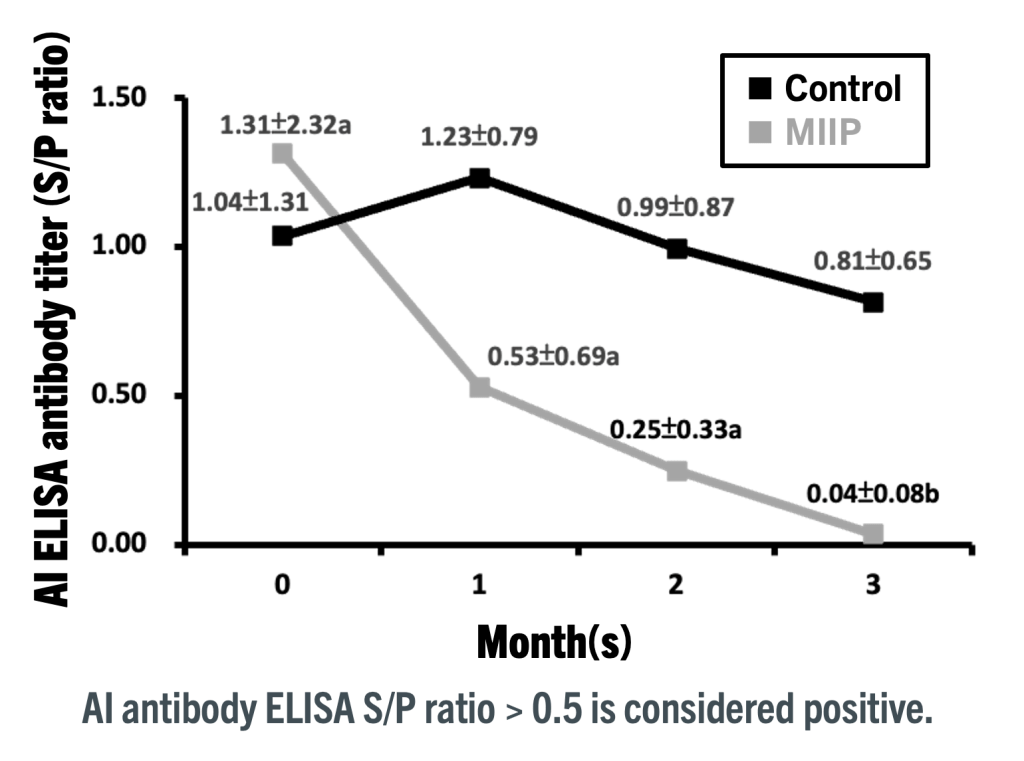
Because the ban of avian influenza vaccine administration in Taiwan, the variation of AI ELISA antibody can reflect the situation of AI inflection of the chickens.

Purpose

Evaluates the MIIP effectiveness on avian influenza virus protection in laying hens.

Objects

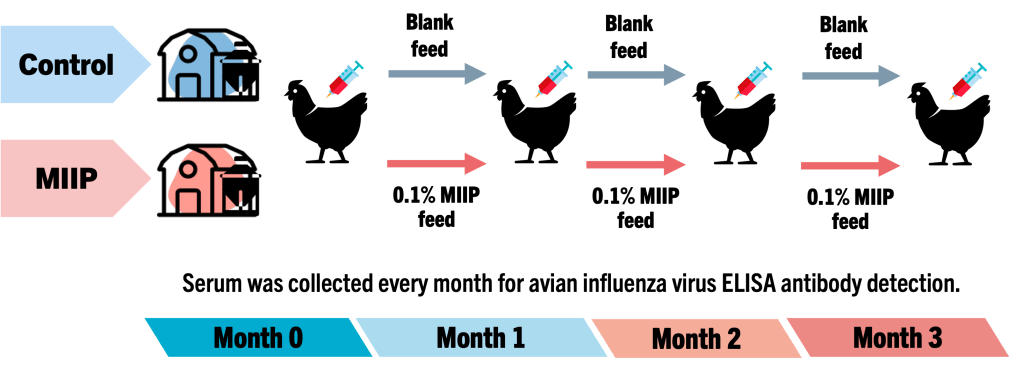
Two houses of laying hens in the same farm.

Method

Results

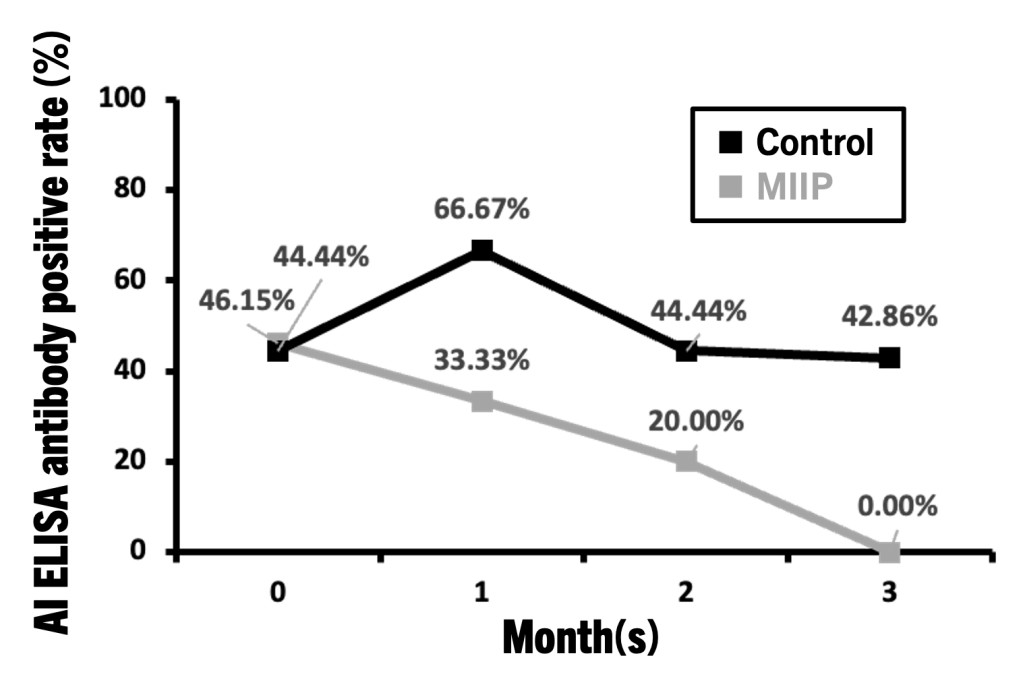
The AI ELISA antibody titer S/P ratio and positive rate were significantly declined after treated with MIIP.

The reduction of AI antibodies in the MIIP-treated group may result from MIIP’s enhancement of IgA antibody production in the mucous membranes, thereby preventing the AI virus from invading the hens’ bodies.

The consistently high AI antibody titer in the control group may be due to ongoing AI infection exposure on the contaminated farm.

Conclusion

MIIP supplementation in laying hens resulted in the clearance of avian influenza virus antibodies. The findings underscore the therapeutic potential of MIIP as a live biotherapeutic product for respiratory diseases.

The efficacy of MIIP treatment against PRRSV infection in a commercial farm


Purpose

It’s impossible to eliminate PRRSV without empty the pigs in the farm, that is why PRRS persistly breakout. In our previous trials, MIIP was found to assist the produce of IgA, which would block PRRS virus out of the mucosa layer and neutralize the virus. The PRRS ELISA antibody was declined without infection happened, the farm could free from PRRS. The purpose of this trial wanted to assess whether MIIP could help the farm free from PRRSV.

Objects

A PRRS ELISA antibody positive farm in Syuejia District, Tainan, Taiwan.

Condition

The PRRS ELISA antibody positive rates were 40% and 80% in 8-week-old pigs and 20-week-old pigs, respectively . MIIP was been added in the feed of whole farm for 3 months. Then, the serum of the pig with the same age were collected to detect the ELISA antibody titer.

Result

After 3 months of MIIP treatment, the positive rates in both of two objects were declined to 0%. It may be due to MIIP induced the specific IgA production, and ceased the invasion of virus from the pigs.

Conclusion

MIIP could capture the PRRS virus from the environment, and induced the generation of antibodies which block PRRS virus, as a result, the antibody titer became negative.

Efficacy of MIIP treatment against PRRSV infection in PRRS antibody-negative pigs


Purpose

Assess whether MIIP stimulates the mucosal immunity.

The Objects

4-week-old pigs *16

Condition

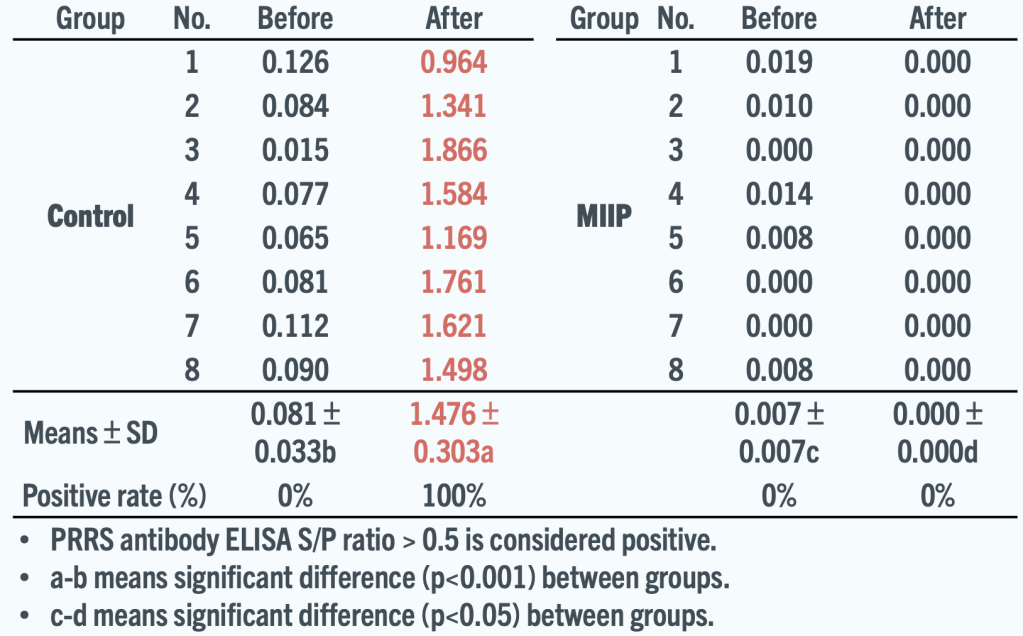
16 pigs were randomly divided into two group. Two groups were rearing in adjacent barns. The experiment group supplied with the feed containing 0.02% MIIP; the control group supplied with the equal amount of the feed without MIIP, and conducted for 4 weeks. The PRRS ELISA antibody was detected before and after the trial.

The experiment condition

PRRS ELISA antibody were showing negative before the trial. After four weeks treating, control group turned to positive, but MIIP group remained negative. It may due to the stimulation of mucosal immunity system, generating the specific IgA, which blocked PRRSV from mucosal membrane, and consequently decreased the pathogen stimulation.

The result

Conclusion

The trial demonstrates MIIP could help IgA generation, that block PRRSV from mucosal layer, which decreases the amount of virus crossing the mucosal layer and consequently lowers ELISA antibody titer.

The comparison after 5 months MIIP treatment and 2 months post-treatment discontinuation


Purpose

In the former simultaneous test, the result showed MIIP induced the generation of the IgA for protection, which reduced the ELISA antibody titer. In order to confirm the immune response, the trial was conducted in a PRRS ELISA antibody positive pig farm to observe the effectiveness of MIIP.

Trial Place

PRRS-outbroken  farrow-to-finish farm in Xiaying District, Tainan, Taiwan.

The objects

8-week-old pigs

Condition

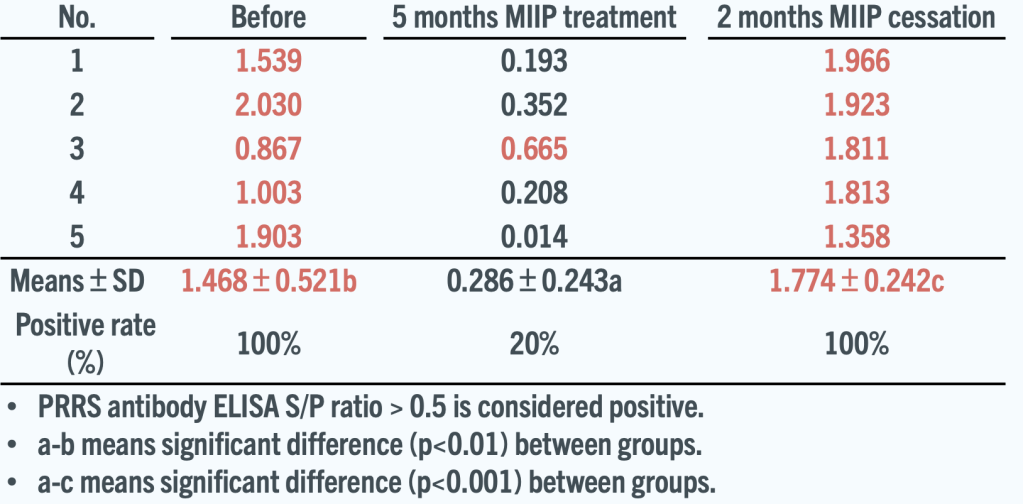
PRRS got outbreak in the farm, and PRRS ELISA antibody of the 8-week-old pigs showed 100% positive before the trial. Then treated with MIIP for 5 months, and 2 months cessation.

The result

The table showed that after the 5 months using, the positive ratio declined to 20%. However, after 2 months of cessation, the positive rate rebounded to 100%.

Accordingly, the farm was surrounding by PRRS virus. But, after the long term of MIIP treatment, PRRSV was blocked by the specific IgA, significantly reduced the pressure of infection. However, the pigs would infect by PRRSV around environment without MIIP protection.

Conclusion

MIIP will inhibit the environmental PRRSV and prevent the outbreak of the PRRS.